Guru Nanak | गुरु नानक | ગુરુ નાનક
ABOUT
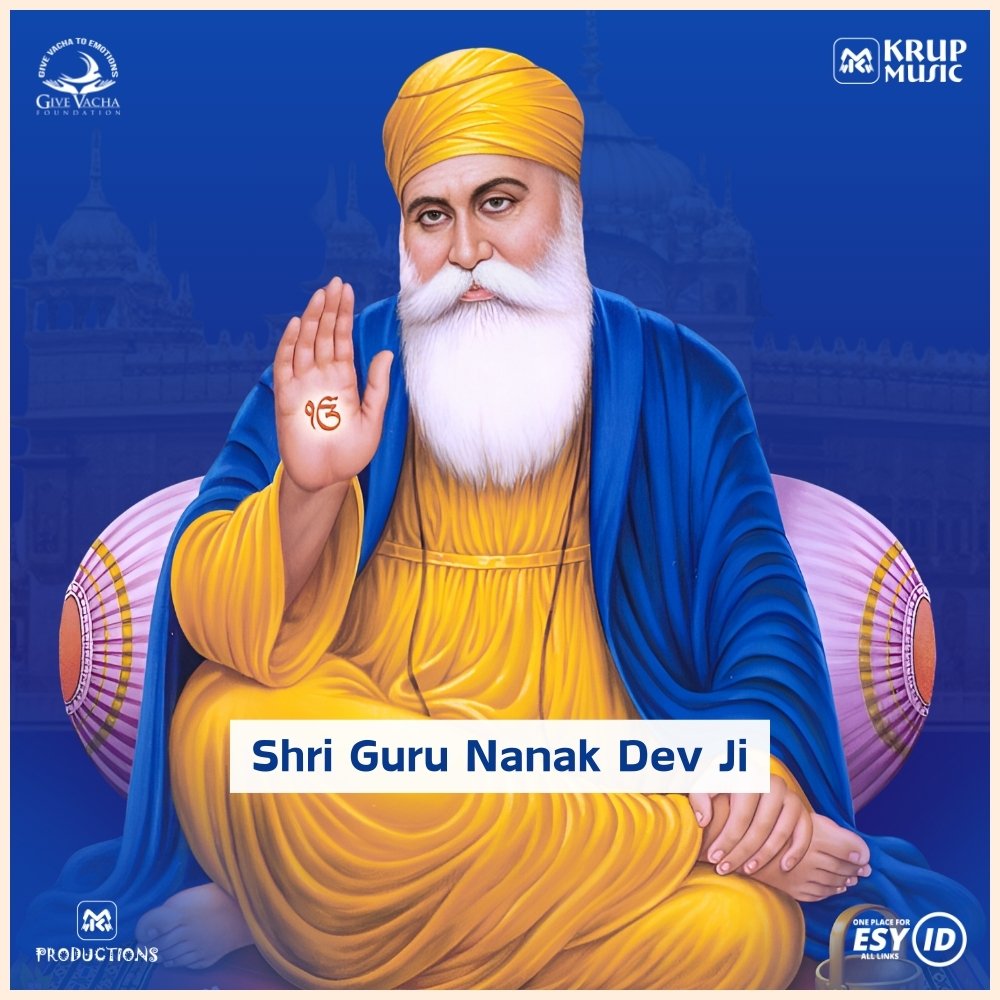
Guru Nanak Dev Ji, the founder of Sikhism, is one of the most revered spiritual leaders in the history of India.
Birth:
He was born on Hindu month of Kartik Purnima (April 15, 1469) in the village of Nankana Sahib (present-day Pakistan).
Death:
He passed away in 1539 at the age of 70 in Kartarpur, a town he had founded, located on the banks of the Ravi River in present-day Pakistan.
Parents:
He was born to Mehta Kalu and Mata Tripta, a well-respected couple in the small town of Nankana Sahib in Punjab. His family belonged to the Khatri caste, which was traditionally associated with trade.
Wife:
He was married to Sulakhani, the daughter of Mula, a respected merchant in the town of Batala.
Children:
He had two sons: Sri Chand and Lakhmi Chand. Sri Chand, the elder son, followed a spiritual path and became the leader of the Udasi sect, while Lakhmi Chand became a household name for his musical talents.
Early Life
From a young age, Nanak exhibited an extraordinary spiritual awareness and an inclination toward devotion. His early life was marked by questions that challenged the societal norms of his time, especially those relating to caste divisions, rituals, and the true meaning of spirituality. His family played an integral role in his early life, and his wife, Sulakhani, supported him in his spiritual journey.
Spiritual Journey
His spiritual journey began at the age of 30 when he experienced a divine revelation. According to Sikh tradition, Guru Nanak had gone for a bath in a river, and when he returned, he declared, “There is no Hindu, there is no Muslim.” This powerful statement symbolized the universal truth that transcends religious boundaries and emphasizes the unity of all humanity under one Creator. He embarked on a life of spiritual exploration, traveling across India, the Middle East, and parts of Central Asia to share his message of unity, equality, and devotion to the one God.
He spent 25 years traveling and spreading his teachings, establishing the foundation for Sikhism. He advocated for living a truthful life, emphasizing three pillars that are central to Sikh philosophy:
- Naam Japna: The practice of meditating on God’s name.
- Kirat Karni: Earning an honest living through hard work.
- Vand Chakna: Sharing with others, especially the needy.
His travels took him to many regions, including present-day Pakistan, Afghanistan, Iran, Saudi Arabia, and Tibet, where he interacted with spiritual leaders and people of different cultures and religions. His teachings advocated for harmony and understanding between all faiths.
The Teachings of Guru Nanak
His teachings were revolutionary for his time, challenging rigid caste systems, ritualistic practices, and societal divisions. Some of his key teachings include:
- One God (Ik Onkar): He emphasized the oneness of God, referred to as “Ik Onkar,” meaning “One Creator.” He rejected the concept of a vengeful or anthropomorphic God, instead promoting a God that is formless, eternal, and omnipresent.
- Equality of All Humans: He taught that all people, regardless of caste, creed, gender, or religion, are equal in the eyes of God. This was a radical idea at the time when society was stratified by caste systems and religious divisions.
- Selfless Service (Seva): Hestressed the importance of selfless service to others, particularly the needy. He believed that true spirituality was reflected in one’s actions toward others, especially through service to humanity.
- Rejection of Rituals and Superstitions: He condemned ritualistic practices, blind faith, and superstitions prevalent in society. He advocated for a direct connection with God through devotion, prayer, and honest living rather than through rituals.
- Naam Simran (Meditation on God’s Name): He taught that meditation on God’s name is the key to spiritual liberation and peace. By repeating God’s name (Naam), individuals could overcome the material attachments of the world and find spiritual fulfillment.
Establishing Sikhism
Guru Nanak Dev Ji established Sikhism as a spiritual path, emphasizing equality, truth, and devotion to God. His teachings were revolutionary, challenging the status quo of the times. His sayings were compiled by his followers, and they later formed the basis of the Guru Granth Sahib, the holy scripture of Sikhism.
Stories and Miracles
There are several stories and miracles associated with Guru Nanak, which illustrate his divine wisdom and spiritual prowess. Here are a few notable ones:
- The River Story: One of the most famous stories about Guru Nanak is his miraculous experience while bathing in the river. After immersing himself in the river, Guru Nanak was missing for three days. When he reappeared, he declared that God is neither Hindu nor Muslim, emphasizing the universality of spiritual truth.
- The Goldsmith’s Challenge: Once, a goldsmith presented a challenge to Guru Nanak, asking him to perform a miracle to prove his divinity. Guru Nanak told the goldsmith to melt his gold and throw it into the river, where it would turn into a precious jewel. When the goldsmith did this, the gold turned into a valuable gemstone, demonstrating Guru Nanak’s spiritual power.
- Feeding the Hungry: In one instance, Guru Nanak’s followers were traveling and were very hungry. Guru Nanak miraculously made a small portion of food last for everyone, demonstrating his compassion and the power of divine grace.
Legacy
Guru Nanak passed away in 1539 at the age of 70 in Kartarpur, a town he had founded, located on the banks of the Ravi River in present-day Pakistan. Upon his death, his followers from both Hindu and Muslim backgrounds fought over the right to bury him. When the sheet that covered his body was removed, it was found that flowers had been placed on both sides, symbolizing his universal appeal to all faiths.
Guru Nanak’s teachings were continued by his nine successors, known as the Gurus, who preserved and expanded upon his philosophy, eventually compiling the Sikh scripture, the Guru Granth Sahib. Guru Nanak’s life and message continue to inspire millions of Sikhs and non-Sikhs alike.
Guru Nanak’s life was dedicated to the promotion of spiritual equality, love, and service to humanity. His teachings transcended religious and cultural boundaries and continue to resonate in today’s world. Through his philosophy of oneness of God, equality for all, and selfless service, Guru Nanak laid the foundation for Sikhism, a faith that advocates for peace, tolerance, and universal brotherhood. His legacy, as a spiritual leader, social reformer, and teacher, continues to guide millions on the path of righteousness and devotion.
Gurudwara
A Gurudwara is a place of worship for followers of Sikhism, serving as both a spiritual and community center. The word “Gurudwara” means “the gateway to the Guru,” symbolizing the Sikh belief that this is where one connects with the teachings of the Sikh Gurus, particularly through the sacred text, the Guru Granth Sahib, which is regarded as the eternal Guru of the Sikhs.
Gurudwaras are open to people of all backgrounds, promoting equality, humility, and service. They offer facilities like the langar (community kitchen), where free meals are prepared and served to all visitors without discrimination, embodying Sikh principles of seva (selfless service) and sarbat da bhala (welfare of all).
The architecture of a Gurudwara often includes a domed hall with the Guru Granth Sahib at its center, a Nishan Sahib (the Sikh flag), and a place for devotees to gather and pray. Some prominent Gurudwaras, like the Golden Temple in Amritsar, have become significant spiritual landmarks, drawing visitors from around the world.
Guru Nanak Songs
| NO | SONG TITLE | SINGER |
|---|---|---|
| 1 | Satnam Waheguru 108 Times | Vacha Thacker, Dr. Krupesh Thacker |
| 2 | Satnam Waheguru Mantra | Vacha Thacker, Dr. Krupesh Thacker, Parv Thacker (Parv Fusion Band) |
| 3 | Satnam Waheguru Jaap | Vacha Thacker, Dr. Krupesh Thacker |
Guru Nanak Jayanti Song | Satnam Waheguru Simran
Here are some trending his songs and mantra by Dr. Krupesh, Dr. Pooja, Vacha and Parv (Parv Fusion Band) for this auspicious occasion.
Guru Nanak Articles
Guru Nanak Temples
| NO | TEMPLE | CITY | ADDRESS |
|---|---|---|---|
| 1 | Lakhpat Gurdwara Sahib or Gurdwara Pehli Patshahi | Lakhpat | Lakhpat, Kutch – Gujarat |
| 2 | Gurudwara Nanakwadi Sahib | Baroda | Near Khanderao Market, Baroda |
| 3 | Shree Guru Nanak Gurudwara | Ahmedabad | New Gurudwara, Sindhi Market, South, Kalupur, Relief Road, Revdi Bazar, Ahmedabad – 380002 |
| 4 | Gurudwara Shri Guru Nanak Dev Ji & Bhai Mohkam Singh Ji | Dwarka | Beyt Dwarka, Distt Dwarka – Gujarat |
| 5 | Guru Nanak Sabha, Guru Nanak Park | Goregaon west | Plot no 92, MG Road,Road Number 5,Tilak Road, near Sidharth Hospital, Goregaon West, Mumbai, Maharashtra 400062 |
| 6 | Gurudwara Guru Nanak Satsang Kalina | Mumbai | 3VG6+W9R, Lotus Lane, Sunder Nagar, Kalina, Santacruz East, opp. Bombay College of Pharmacy India, Mumbai, Maharashtra 400098 |
| 7 | Gurdwara Malad, Sri Guru Nanak Satsang Sabha | Mumbai | 18, Podar Park, behind Vaishnav Haveli, Malad, Malad East, Mumbai, Maharashtra 400097 |
| 8 | Gurudwara Nanak Piao Sahib | New Delhi | 5-A, Bhama Shah Marg, near Nanak Piao Gurudwara, Daulat Ram Dharamvir Axles, Model Town, New Delhi, Delhi, 110009 |
| 9 | Gurudwara Sis Ganj Sahib | Delhi | M64M+92V, Chandni Chowk Rd, Maliwara, Chatta Pratap, Chandni Chowk, New Delhi, Delhi, 110006 |
| 10 | Gurudwara Nanaksar | New Delhi | J5PP+7W3, Gurdwara Ln, Block 1, Old Rajinder Nagar, Rajinder Nagar, New Delhi, Delhi, 110060 |
| 11 | Gurdwara Sri Chola Sahib, Dera Baba Nanak | Punjab | Ward no-03, 22JJ+V5P, Dera Baba Nanak, Punjab 143604 |
| 12 | Sri Darbar Sahib | Punjab | 22MG+CM9, SH25, Dera Baba Nanak, Punjab 143604 |
| 13 | Gurudwara Sri Amb Sahib | Punjab | Mohali Stadium Rd, Sector 62, Sahibzada Ajit Singh Nagar, Lamba, Punjab 160062 |
| 14 | Gurudwara Sri Guru Singh Sabha | Bengaluru | XJGC+F59, Gurdwara Road,Near M G Road Mall, Ulsoor, Nala Rd, Someshwarpura, Bengaluru, Karnataka 560008 |
| 15 | Gurudwara Nanak Mission | Bengaluru | XHQ7+C8J, Brahmapuram, S.S.I.Area, Udayam Nagar, Rajajinagar, Bengaluru, Karnataka 560010 |
| 16 | Gurudwara Sahib | Bengaluru | 2HGH+6WR, 2nd Cross Rd, 1st Block, RMV 2nd Stage, Ashwath Nagar, Armane Nagar, Bengaluru, Karnataka 560006 |
What is Guru Nanak famous for?
Guru Nanak Dev Ji, the founder of Sikhism, is one of the most revered spiritual leaders in the history of India.
What are the miracles of Guru Nanak?
Once, a goldsmith presented a challenge to Guru Nanak, asking him to perform a miracle to prove his divinity. Guru Nanak told the goldsmith to melt his gold and throw it into the river, where it would turn into a precious jewel. When the goldsmith did this, the gold turned into a valuable gemstone, demonstrating Guru Nanak’s spiritual power.
Who was Guru Nanak’s wife?
He was married to Sulakhani, the daughter of Mula, a respected merchant in the town of Batala.
Who is God in Sikhism?
Guru Nanak Dev Ji emphasized the oneness of God, referred to as “Ik Onkar,” meaning “One Creator.” He rejected the concept of a vengeful or anthropomorphic God, instead promoting a God that is formless, eternal, and omnipresent.
What language did Guru Nanak speak?
By 16, he was fluent in Sanskrit, Persian, and Hindi which enabled him to understand many religious texts.
What is the meaning of Ek Onkar?
“Ik Onkar,” meaning “One Creator.”
Why do we celebrate Guru Nanak Jayanti?
Guru Nanak Jayanti is also known as Gurupurab. It is celebrated to commemorate the birth anniversary of the first Sikh Guru, Guru Nanak Dev.
What is Guru Nanak date of birth?
Nanak was born on 15 April 1469 in Rāi Bhoi Dī Talvaṇḍī village (which is now Nankana Sahib, Punjab, Pakistan) in the Lahore province of the Delhi Sultanate. However, according to one tradition, he was born in the Indian month of Kārtik or November, which is referred to as Kattak in Punjabi.
What is the name of the golden temple prasad?
Karah Prasad is a sweet flour-based vegetarian dish served to all visitors to Gurudwaras (Sikh worship places). This is considered food blessed by the Guru and should not be denied.
What is the special food of Gurudwara?
In Gurudwaras, everyone, including Sikhs, can eat the same cuisine in the Langar hall. Langar meals usually feature simple and healthful vegetarian foods like dal (lentils), sabzi (vegetable curry), roti (flatbread), rice and kheer (sweet rice dessert).